I love to take trips to historical places and one long weekend, we took a family trip to Boston to see the sites made famous by the early American revolutionaries; the site of the Boston Massacre, the Boston Tea Party Museum, Paul Revere’s grave, and the church that held the lanterns famous in the “one if by land, two if by sea” quote from the poem, “Paul Revere’s Ride” by Henry Longfellow. We figured that an historical trip like this through early American history would not be complete without a visit to the town of Plymouth, which was about two hours away.
Our first stop was Plymouth Rock, THE Plymouth Rock. Except it turns out it might not actually be THE Plymouth Rock. The signs say as much. In fact, it would have been better to have the sign proclaim in plainer language:
“This is the site where the pilgrims stepped off the boat, except that it might not be, actually, but here’s this big rock that we think may have been the rock they stepped on, or not. But we’ve built this incongruous Romanesque pillar canopy over it, just in case, so enjoy”.
Nearby is the Mayflower II, a detailed replica of the original, amazing for its smallness. My family marveled at how 102 people crammed onto that ship to cross the Atlantic; no toilets, no kitchen, and a steering system which consisted of not a wheel like we see in pirate movies, but a hole in the deck for the captain to holler down instructions to the people controlling the rudder. Utterly unbelievable, and definitely worth the experience. I never really grasped how small and rudimentary a ship it was that these people sailed on for over two months. Being on the ship itself plus information from the helpful signage and the interpreters on board really put into perspective how those people lived while they traveled. My kids did not like my new Mayflower-inspired responses to every complaint they made in the car from that point forward; “Sorry you don’t like that granola bar. Want a dry cracker and scurvy?”.
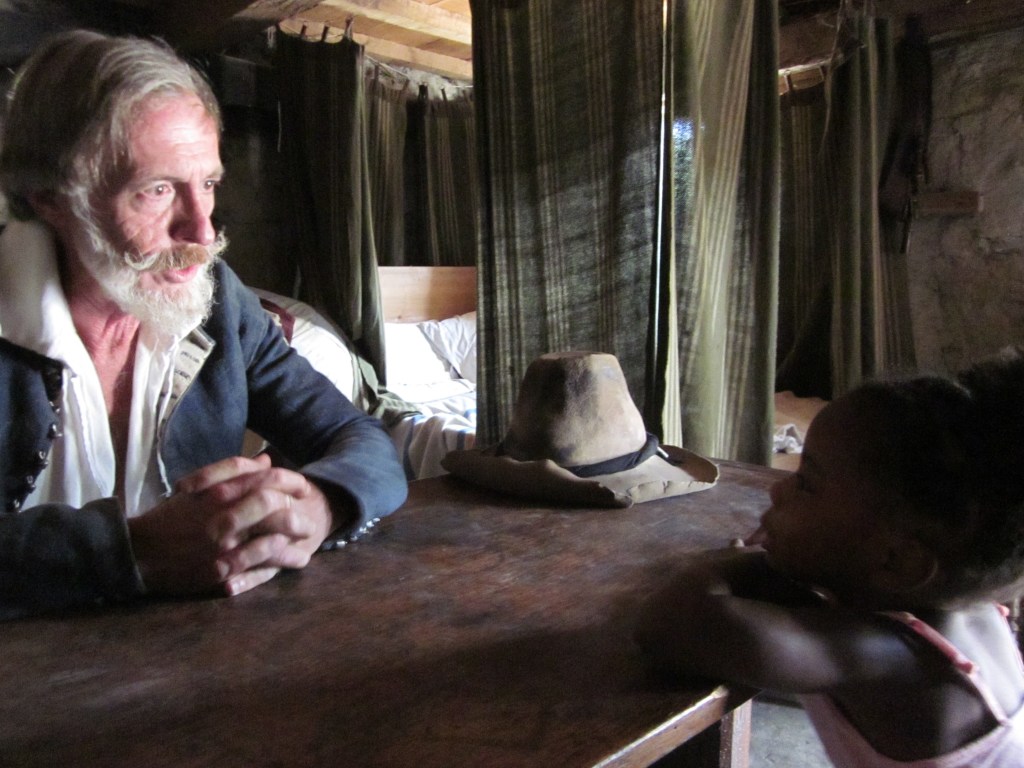
An hour’s drive away is Plimoth Plantation, a replica of the first pilgrim settlement. And just because you may be as curious as I was about the spelling of P-l-i-m-o-t-h, the Plantation (another term for colony) was spelled the way the Governor William Bradford spelled it, as there was no spelling rules in early English language; people just spelled words the way they sounded. The detail here was impressive. Citizens of Plimoth were thatching roofs, mud-daubing walls, harvesting, socializing, sharing a meal, knitting, and each and every one of the re-enactors was completely in character, talking to any tourist as though they were actually from 1627. Each actor takes on the persona of an actual colonist and will take their time with you, as they did my extremely chatty no-man-is-a-stranger younger daughter. They will also leave you to explore on your own, as was appreciated by my you-repulse-me-so-stand-away older daughter, and my I-will-appreciate-you-but-from-afar husband. You can explore at your leisure and see as much of colonial life as you like. Talking to the colonists is key; they will answer as much as you ask. In contrast to the Mayflower, Plimoth Plantation surprised me with its vastness. There was so much detail present in each and every structure and such knowledgeable role-players – it really was a living history experience.
There was also a Wampanoag settlement on the same site, to show the life of the people who were here before the pilgrims. The people here were not re-enactors, but actual Native people who were there to share their culture and history. We sat inside a bark-covered long house speaking to a Native woman about the furs lining the seating area inside for quite a while. There is no rush to move out as others move in or sense of a time limit.
Overall, the day-trip we took to Plymouth was well worth the drive. Plymouth Rock and the Mayflower II were within walking distance of each other and located in a picturesque New England feeling town, complete with beautiful homes and churches on hills. We visited both sites and had a nice seafood dinner on the deck of a local restaurant overlooking the harbor, all worth the drive itself. Add in Plimoth Plantation, and the trip was an extraordinary living history experience. I am so glad I was able to give this non-textbook, living version of history to my daughters.
 Fifty State Family